


Solar CCTV

Off-grid cameras,sized properly.
A 100 W monocrystalline panel with a 600 Wh lithium battery built into the back of it — expandable to four panels as the load grows. Because a camera draws more at night than it does at noon, and winter gives you less sun and more darkness at the same time.
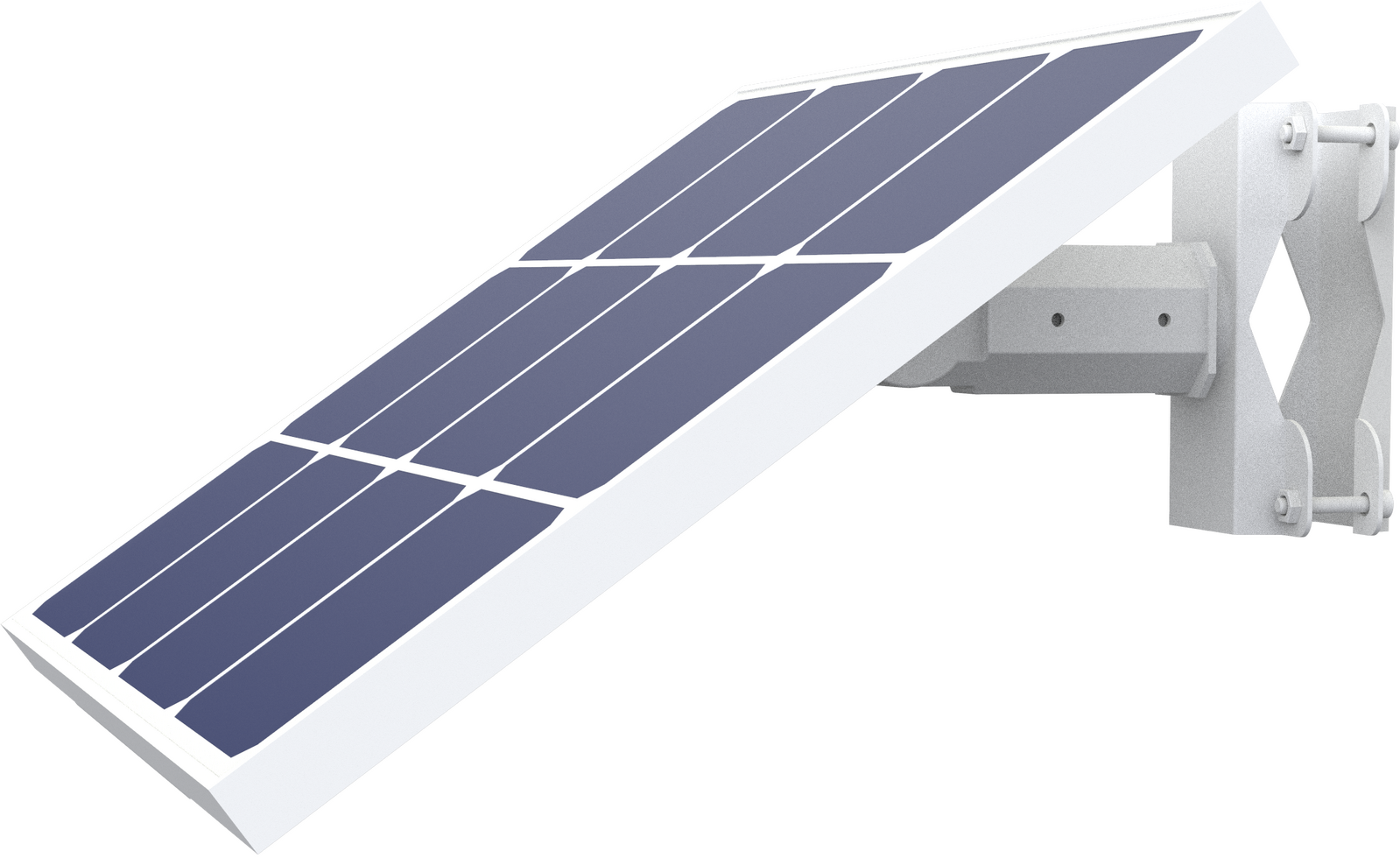
The battery lives on the back of the panel
There is no separate battery box at the base of the pole. The 50 Ah lithium pack is a slimline unit mounted to the rear of the frame, so the whole module lifts as one assembly and there is nothing at ground level to be stolen, flooded or vandalised.
One assembly to install. Panel, battery, controller and heating element ship as a single 15 kg unit including the controller box. Fit the bracket, lift once, connect the load.
Nothing to steal at the base. Conventional solar CCTV puts a battery enclosure at ground level, which is the first thing an intruder finds. Here the storage sits four metres up, behind the panel.
Add a module, add a battery. Because storage is bonded to each panel, scaling the array scales the bank automatically — two modules is 200 W and 100 Ah, four is 400 W and 200 Ah.
The heating element sits with the cells behind the panel, bringing the pack into its 0–45 °C charging window on frosty mornings before charge is accepted.
Most failed solar sites were sized in summer
A single panel and a single battery will run a bullet camera beautifully through February. Then June arrives, the daily harvest halves, and the site starts browning out at 3 am. The camera didn't change — the sun did.
Solar CCTV has two independent sizing questions and they get conflated constantly:
How many panels? That's the daily energy balance. Over 24 hours, the panels must harvest more than the load consumes — measured on the worst month, not the average.
How many batteries? That's autonomy. When a week of cloud arrives and harvest collapses, the battery bank is what keeps the site alive until the sun returns.
Add panels and you fix the daily balance. Add batteries and you fix the dark run. They are different problems, and the modular design exists so you can solve each one without replacing the system.
Size it before you quote it
Pick the load, pick the season and location, and see how many panels the site needs and whether one battery holds through the night.
Estimates only — not a guarantee of uptime. Model assumes 600 Wh nominal battery, 80% usable depth of discharge, 85% conversion efficiency to the device, and a 75% panel derate for temperature, soiling, tilt and controller losses. Figures are for design guidance — confirm against the site and the camera's own draw before committing.
Runtime and panels by camera type
Cameras draw far less in daylight with IR off, and considerably more once it engages. Both are counted here against a Sydney June day — 9.9 hours of light, 14.1 of darkness. One 4G router included in every row.
| Device on the pole | Day | Night | Ah / day | Panels | Night on 1 battery |
|---|---|---|---|---|---|
| Dual-cam LPR measured | 0.67 A | 1.00 A | 33.9 | 2 | 21.9 of 40 Ah |
| Colour247 AISP bullet / turret | 0.40 A | 0.70 A | 22.6 | 2 | 17.6 of 40 Ah |
| Active deterrent | 0.47 A | 0.86 A | 26.0 | 2 | 20.4 of 40 Ah |
| 8 MP Panoramic 180° | 0.70 A | 1.17 A | 35.8 | 3 | 24.2 of 40 Ah |
| PTZ dual-lens | 1.40 A | 2.50 A | 62.3 | 4 | 43.6 of 40 Ah |
| Ajax Hub 2 Plus (off-grid) | 0.31 A | 0.31 A | 20.6 | 2 | 12.1 of 40 Ah |
Every panel brings its own battery
Each LT-MSP-509X is a complete unit: a 100 W panel with its own 50 Ah lithium battery mounted on the back. Connect two to the control box and you have 200 W of panel and 100 Ah of storage. Four is the maximum.
The control box manages the modules rather than simply paralleling them — while one battery feeds the load, another is taking charge from its panel, and the box alternates between them. In practice that means a module is always being replenished whenever there is sun on the array, instead of the whole bank sagging together under load and recovering together afterwards.
Built for poles, not rooftops
Heated cells
Lithium will not accept charge below freezing without damage. The built-in heating element lets the panel charge the battery at low temperature — the difference between a working alpine site and a dead one each winter morning.
Battery on the panel
The 600 Wh slimline pack mounts on the rear of the panel rather than in a separate ground enclosure. One assembly to lift, one bracket to fit, nothing at the base of the pole to be stolen or flooded.
Four panels, one system
The expander cabinet takes the station to 4 × 100 W without replacing the base unit. A site that starts with one bullet camera can take a PTZ two years later on the same infrastructure.
IP66, −40 to 85 °C
Panel rated to 60 m/s wind load and 23 m/s hail. Cell efficiency 21.6%, with output warranted at 90% for 10 years and 80% for 25. Three year system warranty.
Pole options 4–8 m
Plastic-coated Q235 steel poles, threaded flange camera adaptors and bracket kits are all catalogue items. The camera and the panel land on the same pole with no fabrication.
Off-grid Ajax
At roughly 4 W a Hub 2 Plus is a light load, so a single station gives long autonomy. Compounds, remote gates and construction sites get monitored intrusion detection with no mains and no trenching.
Or start from a bundle
Every kit below is the same modular platform with the load pre-matched — expandable later using the same expander cabinet and panels.
Solar Kit Pano
- 100 W AIO solar panel
- 600 Wh LiFePO4 battery
- LTS 8 MP Panorama
- 128 GB SD card
- 4G industrial router
- Pole mount bracket kit
- External pole mount box
Solar Kit Active Det
- Active deterrence camera
- Light and siren response
- Same 100 W / 600 Wh platform
- 4G connectivity
- Suits unmanned compounds
Solar Kit 12M
- PRO-X NDAA compliant camera
- 12 m pole configuration
- Elevated coverage for yards
- Government and civil projects
Ajax Solar Kit — 1 Cam
- Ajax CCTV camera
- Off-grid Ajax ecosystem
- Single-camera compound coverage
Ajax Solar Kit HUBP 2MC
- Ajax Hub Plus
- Two MotionCam detectors
- Verified alarm, fully off-grid
- Remote sites with no mains
Expander Cabinet
- Takes the station to 4 panels
- Houses additional batteries
- Retrofits to existing sites
- The upgrade path, not a rebuild
Sites with no mains and no patience for trenching
Construction and civil. Towers that move every few weeks, where a mains connection would outlast the need for it.
Councils, parks and reserves. Coverage in open space with no building within cable distance and no appetite for civil works.
Rural and agricultural. Gates, silos, water points and boundary runs kilometres from the nearest switchboard.
Car parks and overflow yards. Temporary or seasonal sites where the cost of a trench exceeds the cost of the camera.
Mining and industrial perimeters. Long boundaries where each additional pole would otherwise mean another cable run.
Off-grid alarm. An Ajax Hub Plus with detectors on a compound that has never had power, monitored and verified like any other site.
LT-MSP-509X
| Panel | 100 W monocrystalline, 156Mono cells |
|---|---|
| Panel size | 870 × 670 × 30 mm with frame |
| Cell efficiency | 21.6% |
| Optimum power voltage | 18 V, 5.55 A optimum operating current |
| Open circuit voltage | 21.24 V |
| Battery | 600 Wh lithium, 50 Ah nominal at 12.8 V, 4S6P |
| Battery heating | Built-in element for low-temperature charging |
| Load voltage | 10 – 14.6 V |
| Max load | 40 W standalone · 8 A @ 12 V (plus 2 A @ 24 V) via LT-MSP-CB |
| Max charge current | 10 A |
| Cycle life | ≥1000 cycles |
| Battery temp range | 0 to 45 °C charging · −10 to 60 °C discharging |
| Panel temp range | −40 to +85 °C |
| Wind / hail load | 60 m/s (5 kg/m²) · 23 m/s hail |
| Weight | 15 kg with controller box, excluding pole |
| Expansion | Up to 4 × 100 W panels via LT-MSP-CB |
| Warranty | 3 year system · panel output 90% at 10 yr, 80% at 25 yr |
Site questions
Why quote two wattages per camera?
Because IR illumination is usually the largest single load on the camera, and it only runs after dark. A panoramic camera might sit at 9 W through the day and climb to 15 W once the IR array engages. Sizing on a single flat figure either overstates daytime consumption or, far worse, understates the overnight drain that the battery has to carry.
How many panels does a PTZ actually need?
Four in most southern Australian installs — but panels are only half the answer. A PTZ draws around 18 W by day and 32 W at night with IR and motors active, which comes to roughly 773 Wh across a winter day. Four panels cover that. What they cannot cover is the night itself: at 38 W including the router, one battery lasts about 10.7 hours against 14.1 hours of June darkness. The PTZ site needs a second battery as well as the panels.
Can I run more than one camera?
Yes, within the 40 W controller ceiling. Two Colour247 cameras plus a router is about 20 W and comfortable. Two PTZs is not possible on one station at any panel count — the limit is the controller, not the energy. Split the load across two stations instead.
What happens during a week of rain?
Harvest doesn't stop, but it can fall to a fraction of the clear-sky figure. One battery gives roughly a day of full autonomy on a mid-range camera. For sites that must not drop out, add battery capacity in the expander cabinet rather than adding panels — panels can't help you at night or under heavy cloud.
Does it work in cold climates?
That's what the heating element addresses. Lithium cells can be damaged by charging below 0 °C, so without a heater an alpine site simply won't recharge on frosty mornings. Charging range is 0 to 45 °C, discharge −10 to 60 °C, and the heater lets the panel bring the pack into range before charging begins.
Can it power an Ajax hub instead of a camera?
Yes. A Hub 2 Plus is a modest load compared with any camera, so autonomy is long and a single station is generally ample. This is a strong fit for compounds, remote gates and rural properties that want monitored, verified intrusion detection without a mains connection.
How should I mount it?
Poles from 4 to 8 m in plastic-coated Q235 steel, with a threaded flange adaptor for the camera and bracket kits for the panel. Face the panel true north in Australia and set the tilt closer to vertical than feels natural — steeper tilt favours the low winter sun, which is the month that decides whether the site survives.
Important — sizing guidance, not a performance guarantee
The figures on this page are indicative estimates only. They are not a performance guarantee, a warranty, or a professional engineering assessment. Runtime and panel counts are modelled from generalised assumptions about solar conditions and from typical device consumption. Real-world performance will differ, sometimes considerably.
Actual runtime and recharge depend on factors outside our control, including:
- Weather and seasonal variation — consecutive overcast days, storms, smoke and dust can reduce harvest well below the worst-month averages used here.
- Shading and orientation — trees, buildings, poles, panel tilt and aspect all materially affect output, and even partial shading can disproportionately reduce generation.
- Panel condition — soiling, bird droppings, salt and dust reduce yield, and panels require periodic cleaning.
- Actual device consumption — published wattages are frequently maximums or typicals rather than measured draw, and real consumption varies with IR and white-light activity, motion, recording mode, PTZ movement, heaters, cellular signal strength and firmware.
- Battery condition and temperature — capacity declines with age and cycle count, and both extreme heat and cold reduce available capacity and charge acceptance.
- Installation quality — cable sizing, run length, terminations, voltage drop and system configuration all affect delivered power.
Sizing responsibility rests with the installer or specifier. LTS Security Australia does not warrant that any configuration will deliver a particular uptime, runtime or level of availability, and accepts no liability for loss, damage, downtime, missed recording or consequential loss arising from reliance on this guidance. Where continuous availability is critical, build in additional margin, specify redundancy, and consider a mains or backup supply.
Camera consumption figures shown are indicative and should be confirmed by measurement on a working sample. Specifications may change without notice. Contact our team for a site-specific review before committing to a design — nothing on this page forms part of any contract or quotation.
Tell us the load. We'll size the system.
Send through the camera model, the location and the autonomy you need, and we'll come back with the panel and battery count before you price the job.

